

Blue magic sand is a blue-colored sensory sand. The name covers two different materials: a moldable play sand that packs into shapes and flows loose again, and a hydrophobic sand that stays dry underwater. Most tubs sold for play, including IBIZA’s blue magic sand, are the moldable type, which doesn’t cling to skin or turn into mud the way wet beach sand does. Knowing which grain, coating and binder are in a tub tells you how it will behave in your hands, how it will hold up in storage, and whether it suits a child, a classroom or a craft table.
What Is Blue Magic Sand?
Blue magic sand is a sensory sand sold in a blue colorway. For the moldable type, the defining traits are the same across colors:
- It feels dry and smooth, not gritty or damp.
- It holds a shape when pressed into a mold or squeezed in a hand.
- It crumbles or flows again when you stop pressing.
- It doesn’t need water to hold a shape.
- It leaves little residue on hands, tables or trays compared with wet sand or dough.
The blue itself is only a pigment. The behavior comes from what sits underneath the color, so a blue tub and a green tub of the same sand mold, flow and feel identically. Where colors do matter is in practical use, such as sea and sky themes, contrast against light molds and trays, and how visible stray lint or debris is.
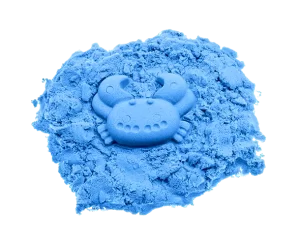
“Magic sand” is not one standardized material. In the toy aisle and online it is applied to two distinct product types. Each has its own construction and its own behavior.
Type 1: Hydrophobic coated sand
This is the original “magic sand” of science kits. Fine grains are treated with a water-repellent coating, commonly a silane-based or silicone-based surface treatment. There is no added binder. Each grain simply carries a thin layer that water can’t wet.
What that does in practice:
- On land: the sand pours and flows like ordinary loose sand. It does not hold a sculpted shape well, because nothing glues the grains together.
- In water: submerged sand can be pushed into a mound that holds together while under water, and it comes out dry. Air clings to the coated grains, which gives the surface a silvery sheen.
- On removal: lift a handful out of a glass of water and it pours off dry, with no clinging moisture.
This type is mainly a science demonstration. It is sold in small quantities, and the appeal is the water trick rather than the shaping. The chemistry of hydrophobic sand comes down to that coating: it bonds to the grain surface, so water beads up instead of soaking in.
Type 2: Moldable polymer-bound sand
This is the type most people mean when they say blue magic sand for play. Fine grains are combined with a small amount of a silicone-based polymer or oil binder. The binder coats the grains lightly, so they cling to each other more than to your skin.
What that does in practice:
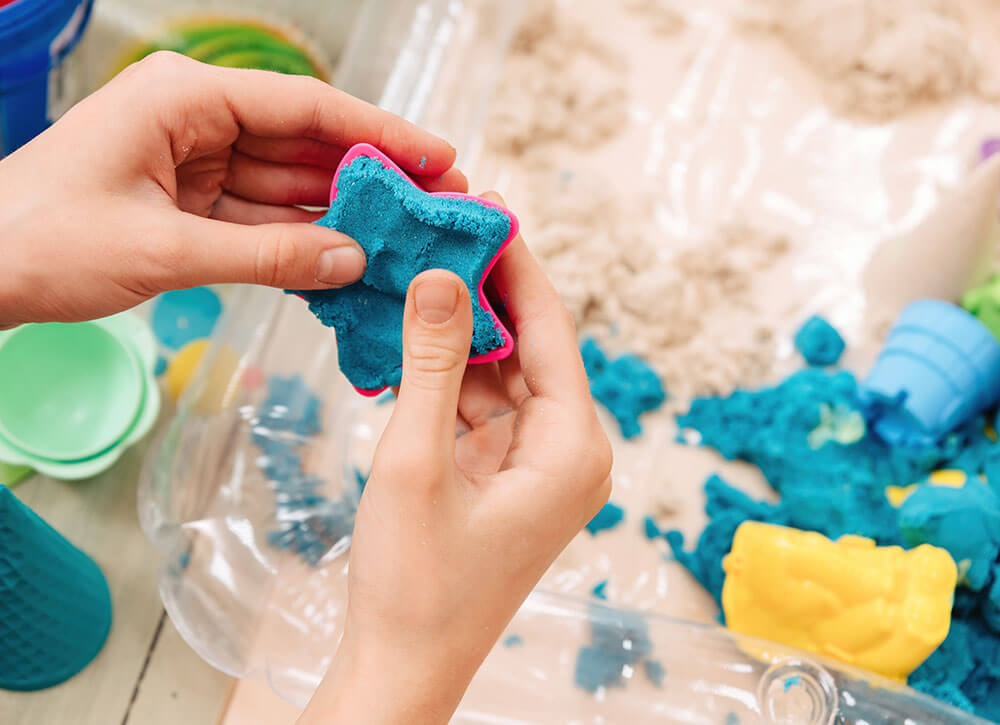
- On land: the sand packs into castles, stars and animal shapes, holds edges, and can be cut cleanly with a plastic knife. Pull it apart and it drops back into loose, flowing strands and crumbs.
- In the hand: it feels soft and slightly cohesive, not sticky. It is designed to leave hands mostly clean.
- Around water: the silicone binder resists a light splash, but this is not a water-play sand. Soaking changes how it feels until it dries, and it doesn’t do the underwater trick of Type 1.
This is the product used for indoor play, sensory tables, craft projects and kits with molds and tools. It is also the category where “kinetic sand” as a brand name became shorthand for the whole product type.
| Hydrophobic coated sand | Moldable polymer-bound sand | |
|---|---|---|
| Grain | Fine sand or bead grains | Fine sand or bead grains |
| Surface treatment | Silane or silicone-based water-repellent coating | No separate coating; the binder coats the grains |
| Binder | None | Small share of silicone-based polymer or oil binder |
| Dry behavior | Flows freely, poor shape retention | Packs, molds, holds edges, crumbles on release |
| Water behavior | Stays dry when submerged and holds a shape underwater | Resists a light splash, but should not be soaked |
| Typical use | Science demonstration | Play, sensory activities, crafts, kits |
| Typical pack | Small jars or tubes | Tubs, bags, kits, bulk packs |
What blue magic sand is made of
Typical components across brands; not a brand specification.
| Component | Typical material | Role |
|---|---|---|
| Grains | Silica sand or glass beads | The bulk of the product. They set the feel: rounder grains flow and feel smoother. |
| Surface coating | Silane or silicone-based treatment (hydrophobic type only) | Makes the grain surface repel water. |
| Binder | Silicone-based polymer or oil (moldable type only) | Lets grains cling to each other so the sand holds a shape. |
| Pigment | Cosmetic-grade or toy-grade colorant | Gives the blue. It should stay in the sand rather than transfer to skin or fabric. |
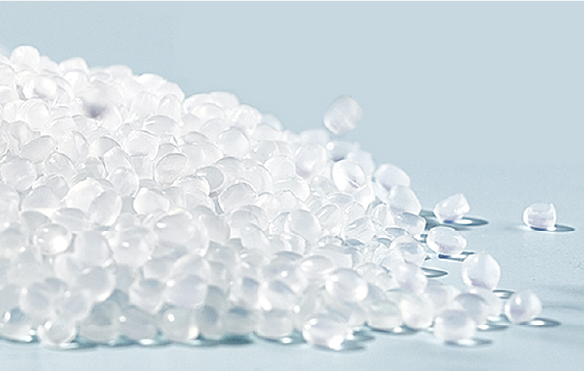
Grain size. Moldable sands in this category commonly use very fine grains, comparable to fine beach sand or finer. Finer, rounder grains produce a smoother, more flowing feel. Coarser or angular grains feel scratchier and crumble more. IBIZA describes its grains as ultra-fine, smooth, round glass beads but doesn’t publish a numeric grain size, so ask for the specification if it matters for your use.
Glass beads versus silica sand. Chemically the two are close, since glass is made mostly of silica. The difference is shape. Silica sand is mined and its grains are angular and irregular. Glass beads are melted and formed into round, uniform spheres. Round grains roll over one another easily, which is why moldable sands built on them flow so smoothly. The trade-offs between glass beads and silica sand in moldable play sand show up in feel, flow and how uniform the grains are from batch to batch.
Grain, coating and binder together explain what is in magic sand and why it behaves so uniquely compared with ordinary sand.
Where IBIZA’s blue magic sand fits
IBIZA Sand manufactures moldable, sensory magic sand, so its blue magic sand belongs to Type 2. It is made from ultra-fine glass beads using IBIZA’s patented spherical glass bead technology. The binder is a high-temperature-resistant organic silica gel (a silicone-type material), which IBIZA says keeps the product from deteriorating in transit. IBIZA describes the finished sand as non-toxic, odorless, non-sticky to hands, soft, able to hold shape and free-flowing, and says it “will not dry out.” That last point is a manufacturer claim that still depends on how the sand is stored.
IBIZA does not sell the branded Kinetic Sand product. It makes its own sand and supplies distributors, toy retailers and OEM/ODM partners.
Blue Magic Sand vs Blue Kinetic Sand vs Blue Play Sand: What the Names Mean
Three labels overlap on shelves and in listings. They are not interchangeable.
| Name on the label | What it usually means | What to keep in mind |
|---|---|---|
| Magic sand | A general name for moldable or water-repellent sand | Not a brand. Materials and quality vary by maker, and the term can mean either type above. |
| Kinetic Sand | A specific brand name that has become common shorthand for moldable sand | A tub described as “kinetic sand” is not automatically the branded product. |
| Play sand | Ordinary loose sand, often sold with buckets and molds | Doesn’t mold the same way. It needs moisture to hold a shape and falls apart as it dries. |
The mix-ups show up in real listings. Take a 4 lb play-sand bag versus a 5 oz moldable tub: both can carry the name “blue magic sand,” yet they differ in texture, pack size, what’s included and how the sand behaves once it’s out of the container.
There is also a practical difference in what you do with each:
- Blue play sand suits outdoor digging and sandbox use. Build with it wet, expect it to dry and crumble, and expect a mess on floors.
- Blue moldable magic sand suits tabletop and indoor play. It holds shape without water and tends to stay on the tray.
- Blue hydrophobic sand suits a glass of water and a curious child for a short science demonstration.
Between the branded and generic products, the practical differences in magic sand vs kinetic sand come down to grain, binder and feel rather than the name on the tub.
What Blue Magic Sand Is Used For
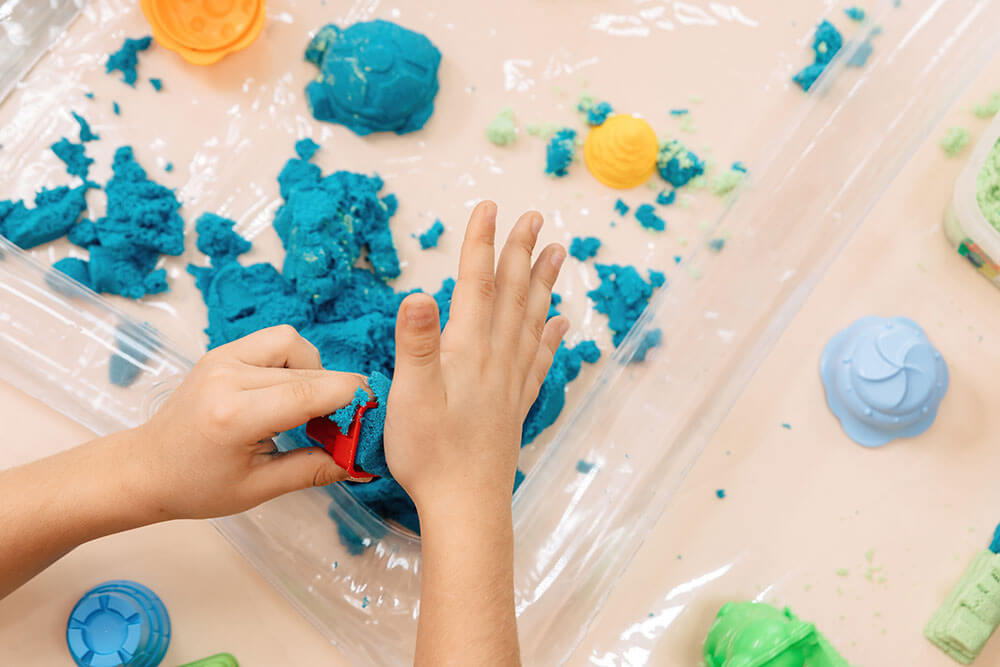
Blue magic sand is used the same way as any moldable sensory sand. IBIZA groups its applications under relax, kids, crafts, art and teach. The blue colorway lends itself to a few themes in particular.
Open-ended sensory play
The most common use is unstructured play: pressing, squeezing, cutting, pouring and shaping. The sand gives resistance without being sticky, which is why it is popular for indoor sensory tables and quiet-time trays. A shallow tray or a tabletop bin keeps loose grains contained. Add spoons, cups, small rakes and cookie cutters. Because the sand doesn’t need water, the play starts as soon as the lid comes off.
Themed scenes and imaginative play
Blue is the natural choice for water and sky:
- Ocean scenes: waves, tide pools, shorelines and sea creatures. Crab, shell and fish molds pair well with blue sand.
- Sky and space: clouds, planets, night scenes. Dark blue sits well behind small toy figures.
- Winter and ice themes: icebergs, igloos, frozen landscapes. Mix in white or light sand for contrast.
- Layered designs: stacking blue with other colors to build striped landscapes.
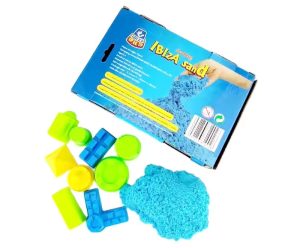
Blue also contrasts well against bright molds and tools. A kit with yellow or orange accessories reads clearly against the sand and makes it easy to spot pieces.
Crafts and sand art
Moldable sand can be pressed into shapes, layered in clear containers and used as texture in craft projects. The finished work is not permanent the way glued sand is, since the grains stay loose. It is closer to a sculpting medium you can rework over and over. Layering works best in a clear, sealed jar, where the colors stay distinct.
Teaching and learning activities
Educators use moldable sand for hands-on activities: shape and letter formation, counting, pattern building, and simple cause-and-effect exploration. Blue helps in color-sorting and color-mixing lessons, especially against primary and secondary colors. Water demonstrations, such as pouring sand into a glass of water and lifting it out dry, need hydrophobic coated sand; moldable sand won’t do the trick.
Calming, low-pressure activity
Many people find the slow, repetitive motion of pressing and crumbling sand relaxing. That’s a comfort observation, not a treatment claim. Blue magic sand is a toy and craft material, and it isn’t a medical or therapeutic product.
Party, event and retail uses
Blue moldable sand appears in party favor tubs, activity stations, classroom kits and retail play sets. In those settings the practical concerns are quantity, packaging and consistency between batches, which is where sourcing from a manufacturer matters.
What to Check Before You Buy Blue Magic Sand
The name on the label doesn’t tell you what’s in the tub, so the listing and the product itself have to. These are the checks that matter most.
Read the listing
- The material is named. “Magic sand” alone tells you little. Look for a plain statement of what the grains are, such as glass beads or silica sand, and whether it is moldable or hydrophobic. A vague listing usually means a vague product.
- The type matches your use. If you want a shaping material, confirm it is moldable and not a coated science sand that only holds shape underwater. If you want a water demonstration, confirm it is hydrophobic.
- Toy-safety standards are named. Standards such as EN 71 (Europe) and ASTM F963 (United States) are the usual reference points. A reputable seller can supply the supporting test reports on request. GB 6675-2025, EN 71 and ASTM F963 differ in scope, so check which one applies to your market.
- Age labeling and small-part warnings are present. Most moldable sands are labeled for ages 3 and up, and kits with molds, tools and figures often include pieces small enough to be a choking hazard. Follow the label.
- Storage guidance is included. A sealed container and a dry place matter for any moldable sand.
- Pack size and contents are clear. Confirm the net weight and whether tools and trays are included.
Inspect the tub when it arrives
A quick inspection takes a minute and avoids most problems. Put a spoonful on a sheet of white paper and check these points:
- Debris and contamination. Look for hair, lint, fibers, insects or anything that doesn’t belong. Open a new tub over a tray so you can see any surprises.
- Smell. Moldable sand should have little or no odor. A strong chemical, oily or musty smell is a reason to stop and ask the seller.
- Color transfer. Blue is a strong dye color, so it shows transfer more clearly than most. Use the test below before letting children play.
- Feel and cohesion. Squeeze a handful. Good moldable sand holds together, releases cleanly and leaves your palm mostly clean. Sand that stays powdery, or that stays as one greasy clump, isn’t behaving as it should.
- Oily film. A shiny or wet-looking film on the surface, or oil pooling in the container, is a warning sign of a poorly balanced binder.
- Seal and container. The packaging should be intact and clean, with no gaps around the lid.
If any of these checks fails, stop, seal the tub and contact the seller before children play with it.
A simple dye-transfer test for blue sand
Do this once with every new tub or batch, using a small amount:
- Press a pinch of sand firmly onto a white paper towel or white cloth and rub for about 30 seconds. A faint dusting is normal. Streaks or a blue smear are not.
- Repeat with a slightly damp towel, since damp hands and a splash of water are what real play involves.
- Squeeze a handful in a dry palm for a minute, then wipe your hand on white paper. A blue palm means the pigment isn’t staying in the sand.
- Press a mound onto a light-colored tray or tablecloth for a few minutes and check for staining.
If the color comes off in any of these, don’t use the sand near fabric, wood or light-colored surfaces, and ask the seller how the pigment is bonded. In a well-made colored sand, the pigment is bonded to the grains so it doesn’t transfer to hands or cloth.
Handling in the first week
Play over a tray or shallow bin, and keep food and drinks away from the play area. Brush loose sand back into the container rather than washing it down a sink drain. Wash hands after play, and don’t let anyone eat the sand, even if the manufacturer describes it as non-toxic.
Weighing the pros and cons of blue magic sand helps too: it is clean, reusable indoor play, but a strong blue shows any dye transfer more readily than paler shades.
Caring for Blue Magic Sand: Wet, Dust, Light and Storage
Moldable sand is low-maintenance, but a few habits determine how long it stays pleasant to use.
Keep it sealed. Air brings dust, hair and humidity into the tub. A tightly closed lid or a zip bag inside a box works. Store it away from direct heat and out of damp rooms.
Keep it out of strong light. Colorants in any dyed product can lighten over time under prolonged direct sunlight and heat, and a saturated blue may show the change more than a pale shade. Keep tubs on a shelf or in a cupboard instead of on a sunny windowsill, and avoid leaving open trays in direct sun. Fading changes the shade only, and it doesn’t affect how the sand molds.
Keep it clean. Dust and pet hair are the usual culprits. Don’t play on carpet or on a dusty floor, and use a clean tray. Small debris can be picked out with tweezers or a fork. Sand that is heavily contaminated is usually not worth rescuing.
Watch the water. Moldable sand tolerates a light splash, but soaking is different. Trapped moisture can change how the sand feels and can encourage mold in a sealed container. Let it dry fully before sealing it again. The underwater trick belongs to hydrophobic magic water sand, not to moldable play sand.
Don’t mix colors permanently. Blue mixed with yellow gives green, and once mixed the colors are hard to separate. If you want colors to stay distinct, give each color its own tray and container.
Signs it’s time to replace it. Loss of cohesion that doesn’t recover, persistent odor, visible mold, or heavy contamination all mean the sand has reached the end of its useful life.
Small Tubs or Bulk: How Blue Magic Sand Is Sold
Pack size depends on who is buying.
For home use: single tubs and kits from a retailer are the easiest option. A kit with molds and tools suits a first purchase, since you get accessories along with the sand. The listing checks above apply to any tub.
For larger quantities: classrooms, events, craft workshops and resale usually need more sand than retail tubs supply sensibly. That volume comes from manufacturers such as IBIZA, which supplies blue magic sand in bulk to distributors, toy retailers and OEM/ODM partners rather than selling single tubs. Bulk and prepackaged private-label formats cover bags, boxes and jars.
Blue is one of several standard colors, and custom colors are available on request. For a larger project or a private-label range, IBIZA Sand quotes by quantity, packaging and color.
Frequently Asked Questions
-
What can blue magic sand be used for?
Blue magic sand is used for open-ended sensory play, ocean and sky-themed scenes, craft and sand-art projects, and hands-on teaching activities such as shape, counting and color-mixing lessons. Blue also suits party favors and activity stations, where it contrasts well with brightly colored molds.
-
What happens if blue magic sand gets wet?
It depends on the type. Hydrophobic coated sand comes out of water dry, which is the whole point of magic water sand. Moldable play sand tolerates a light splash, but a soaked tub changes texture and can grow mold, so let it dry completely before sealing it.
-
What's the difference between kinetic sand and blue magic sand?
"Magic sand" is a general term for moldable or water-repellent sand from many makers. "Kinetic Sand" is a specific brand that people use as shorthand for the whole category. A blue tub labeled magic sand isn't the branded product, and a blue tub of the branded product is only one version of the category. Both are usually polymer-bound moldable sands.
-
How long will blue kinetic sand last?
There is no fixed lifespan. A tub stays usable for as long as it stays clean, sealed and free of moisture, and dust, hair and humidity shorten that. IBIZA says its magic sand does not dry out, a manufacturer claim that still depends on proper storage. Replace any sand that smells musty, shows mold or won't hold together.
-
Is blue magic sand safe for kids?
IBIZA's magic sand is China 3C certified, tested against EN 71 and ASTM requirements, and described as non-toxic. Safe use still depends on how it's used. Follow the age label (usually 3 and up), supervise young children, keep sand out of mouths and noses, and ask any seller for its test reports before you buy.
-
Can I make blue magic sand at home?
You can make a moldable, sand-like mixture at home and tint it blue. Homemade versions usually differ from manufactured sand in feel, cohesion and durability, and they're more likely to dry out or crumble. The hydrophobic type is harder to reproduce because it depends on a real water-repellent coating on the grains.
-
How do I test blue magic sand for dye transfer?
Rub a pinch of sand on a white paper towel, then repeat with a damp one, and squeeze a handful in a dry palm for a minute. A faint dusting is normal. Streaks, a blue palm or stains on a light tray mean the pigment isn't bonding well, so keep the sand away from fabric and light surfaces and ask the seller about it.
-
Does blue magic sand fade?
Any dyed material can lighten with prolonged exposure to strong sunlight and heat, and no fixed fade rate applies to every brand. Store the tub sealed, in a cupboard or on a shelf out of direct sun. Fading changes the shade only. Color that rubs off on hands or cloth is a different problem, caused by the pigment not bonding to the grains.