

Push water-repellent sand into a glass of water and it comes out dry. Press moldable sand into a cup and it holds a cut edge. Pour ordinary dry sand and it runs into a low cone. Each difference makes a simple magic sand science experiment that kids can predict, measure, and explain, using plain dry sand and damp sand as controls.
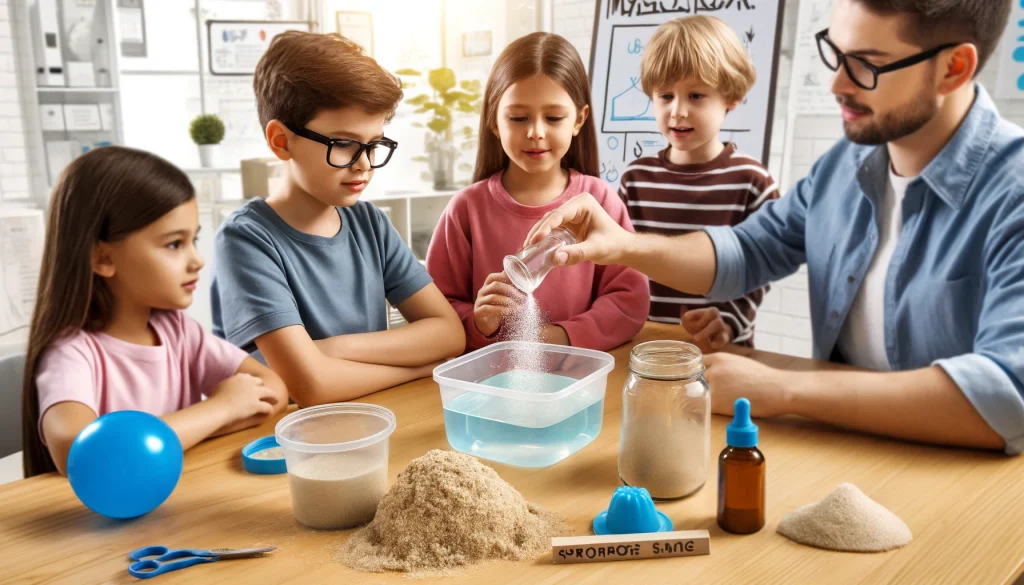
First, which “magic sand” do you have?
“Magic sand” names two different materials, and the right experiments depend on which one is on your table.
| Type | What it is | Behavior | Experiments |
|---|---|---|---|
| Water-repellent (hydrophobic) sand | Ordinary sand with a water-repellent coating | Stays dry underwater | 1 |
| Moldable sensory sand | Play material that holds shapes. IBIZA describes its version as glass beads with a silicone/silica-gel binder | Molds, cuts, and flows | 2–6 |
IBIZA’s Magic Sand is the moldable type and is not marketed as water-repellent. Other brands may differ.
What you need and quick safety notes
- A tray, clear cups, a funnel, and a spoon
- A kitchen scale (grams), a ruler, a timer, and a small magnet
- A magnifying glass and dark paper
- Plain dry sand and a bowl of water as controls
- A notebook or printed results table
Keep an adult present, keep sand out of mouths and eyes, and wipe up so sand doesn’t go down a drain. Homemade water-repellent sand means spraying dry sand with fabric protector. That is adult-only work, done outdoors or in a well-ventilated space, and not a classroom prep task.
6 magic sand science experiments
1. Does it stay dry underwater? (water repellency)
Water-repellent sand only.
- Question: Will treated sand get wet when submerged?
- Prediction: Write down what you expect before you start.
- Steps: Pour 250 ml of water into each of two clear cups. Add 50 g of treated sand to one and 50 g of plain sand to the other. Stir gently, then scoop some out.
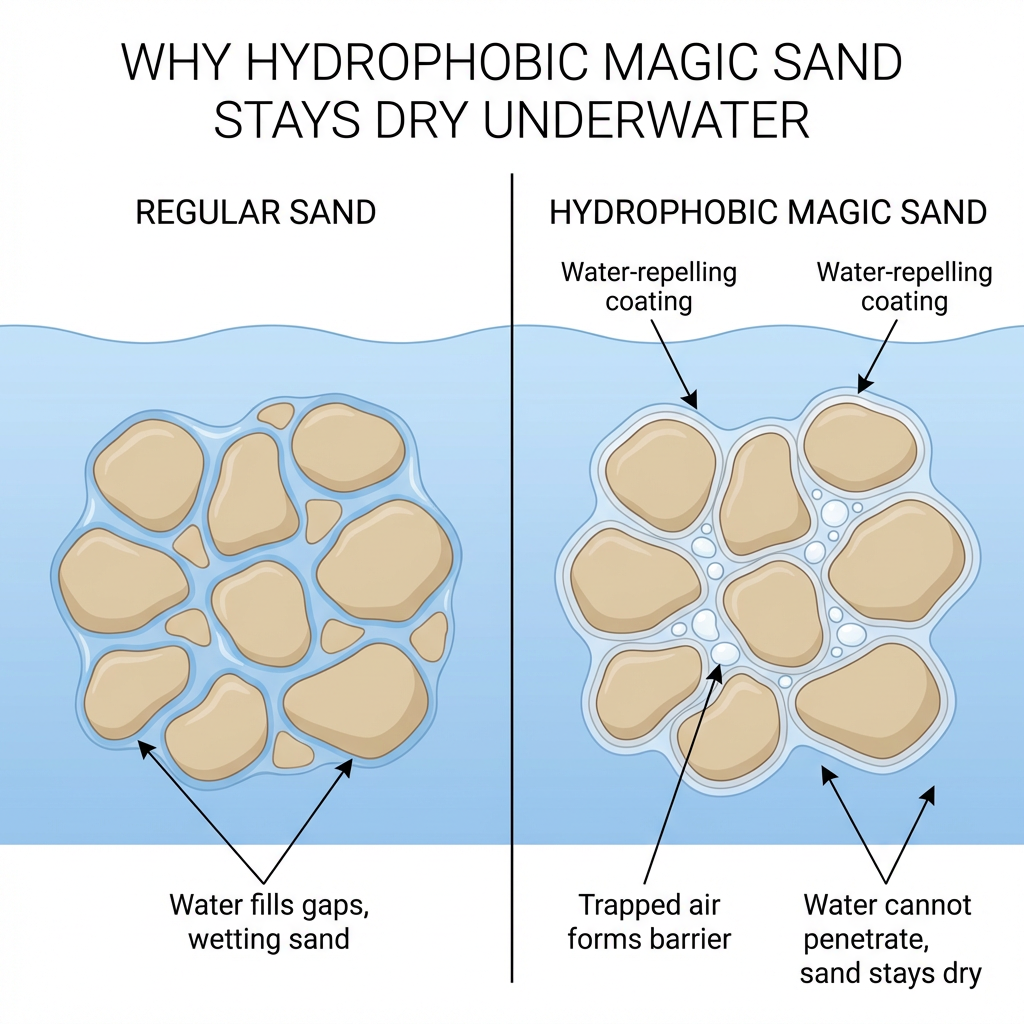
- What you’ll see: The treated sand clumps and looks silvery underwater, then comes out dry. Plain sand turns to wet mush.
- Why: The coating repels water, so surface tension holds water in beads instead of letting it soak in, and a thin layer of air stays trapped around the grains. That is why this sand doesn’t mix with water. It is the type sold as magic water sand.
2. Can it hold a shape? (cohesion test)
- Question: Which sand can be molded, cut, and stacked?
- Prediction: Rank dry sand, damp sand, and moldable sand from best to worst.
- Steps: Make damp sand by mixing 15 ml of water into 100 g of dry sand. Pack 100 g of each sand into the same cup, flip it onto a tray, cut with a spoon edge, then stack a second layer.
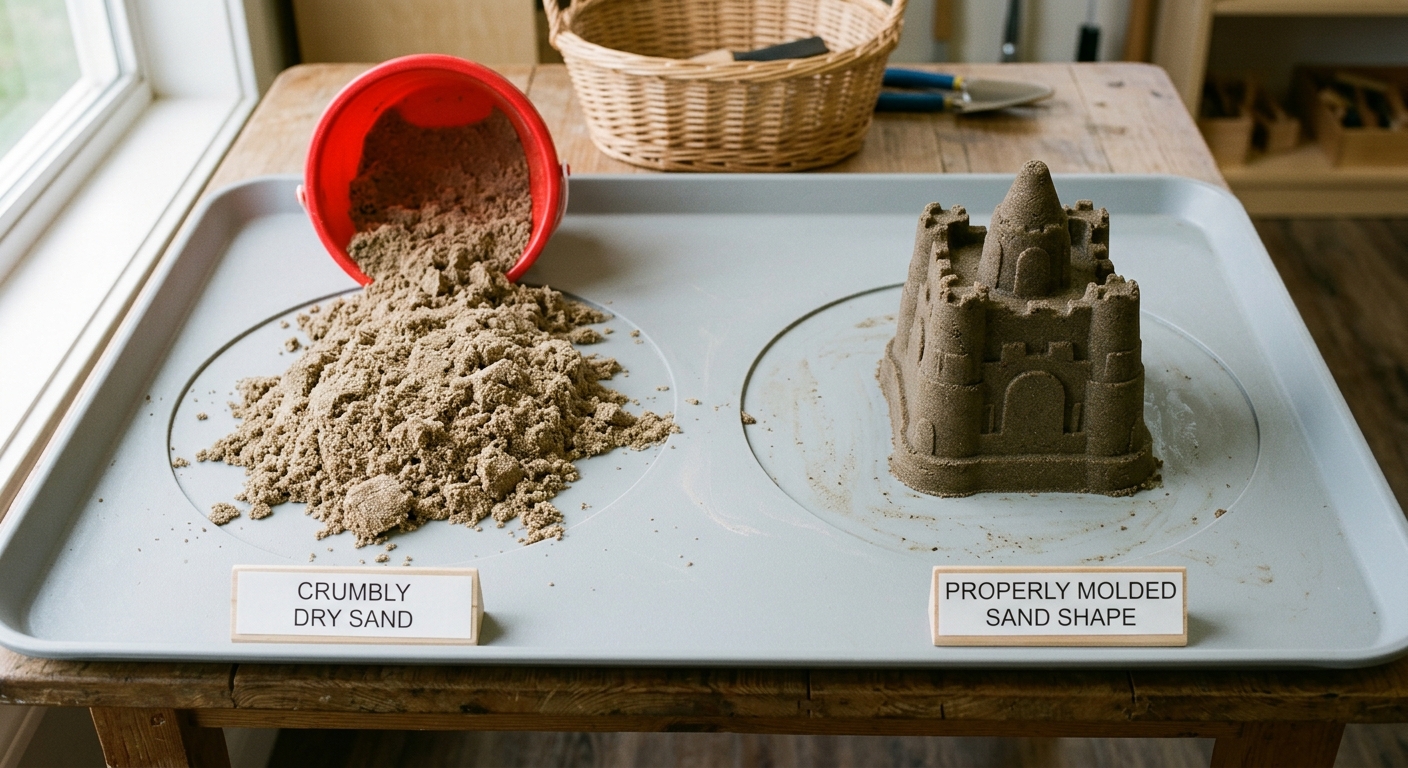
- What you’ll see: Dry sand collapses. Damp sand holds until it slumps or dries. Moldable sand keeps clean edges.
- Why: Grains that bind to each other resist falling apart, which is cohesion. If a moldable sample crumbles, its cohesion has failed.
3. Pile, pour, or flow? (angle and speed)
- Question: How does each sand pour?
- Prediction: Which pile will be steepest? Which will empty the funnel first?
- Steps: Pour 100 g of each sand through the same funnel onto a tray and time it. Measure pile height and radius, then calculate angle = arctan(height ÷ radius). Repeat three times.
- What you’ll see: Dry sand runs fast and forms a cone. Moldable sand tends to move slowly and in clumps, somewhat like a very slow liquid.
- Why: Grain friction and grain shape control flow. Moldable sand’s liquid-like flow comes from grains that cling and slide together.
4. Look closer: grain shape under a magnifier
- Question: Do the grains look different?
- Prediction: Sketch what you expect to see.
- Steps: Spread a pinch of each sand on dark paper, look through the magnifier, and draw what you see.
- What you’ll see: Ordinary sand grains look rough and irregular. IBIZA describes its product as spherical glass beads, so expect smoother, rounder grains.
- Why: Shape affects how grains slide past and lock against each other, which ties back to Experiments 2 and 3.
5. Does it dry out? A one-week observation
- Question: What changes when each sand is left open?
- Prediction: Which sample changes most after seven days?
- Steps: Put 50 g each of dry sand, damp sand (7.5 ml of water, the same ratio as Experiment 2), and moldable sand on open trays. Keep a sealed 50 g sample of each. Photograph and press-test them daily.
- What you’ll see: Damp sand dries and crusts. IBIZA Magic Sand is sold as sand that “will not dry out,” so you can check that claim yourself. Homemade mixes often behave differently.
- Why: Evaporation removes water, which is why sand dries out when left open. The test also teaches variables and long-term observation.
6. Is it magnetic? A prediction that may fail
- Question: Will a magnet attract any of the sands?
- Prediction: Many kids guess yes.
- Steps: Hold a magnet 1 cm above 50 g of each sand, then touch it to the surface. Record the result.
- What you’ll see: Usually nothing, unless the sand contains iron. Moldable sand doesn’t respond to magnets, and a wrong prediction shows a hypothesis can be tested and be wrong.
- Safety: Use one large magnet, not small or button magnets that a child could swallow, and don’t give children loose iron filings.
Make it a real experiment (fair test tips)
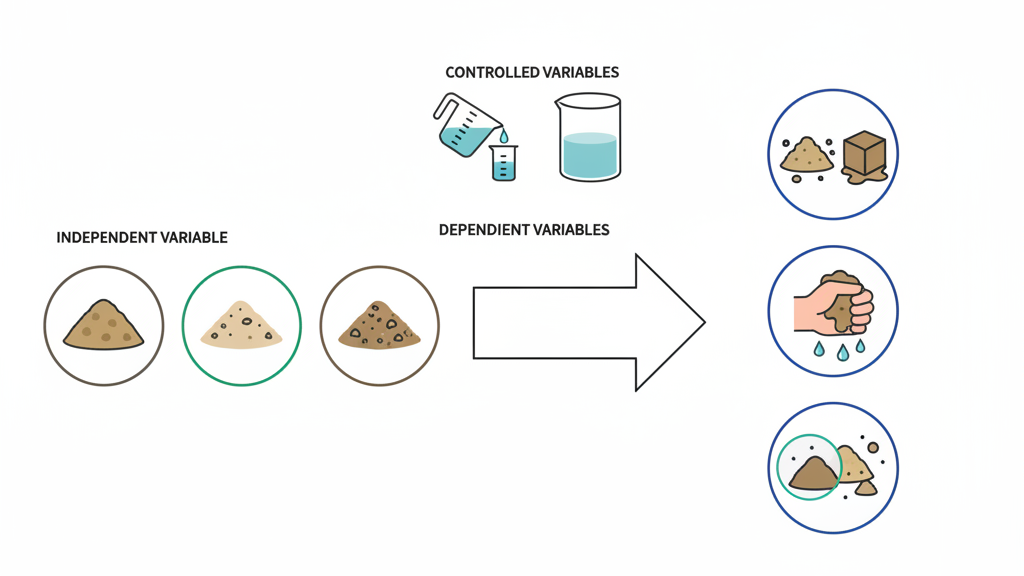
- Change one variable at a time.
- Use equal amounts, the same tray, and the same tool.
- Repeat each test three times and record every result in a table.
- Write a one-sentence conclusion saying whether your prediction held.
Magic sand vs. kinetic sand for experiments
“Kinetic sand” began as a brand name and is now the common name for moldable sand, while “magic sand” also covers the water-repellent type. Experiments 2–6 work with moldable sand, and Experiment 1 needs the water-repellent type. Texture, binder and water behavior differ too; compare them in magic sand vs. kinetic sand.
Getting enough sand for a class or group
Each test uses 50–100 g per group, but a full class goes through more than you might expect. Programs can source bulk magic sand for classes and programs in several colors, and a tray per group keeps a sensory sand station contained.
Need a class set for these experiments? Request a quote.
FAQ
-
What are the ingredients in magic sand?
It depends on the type. Water-repellent "aqua" sand is ordinary sand with a hydrophobic coating. Moldable sensory sand is a separate product; IBIZA describes its version as glass beads with a silicone/silica-gel binder. Other makers' formulas vary; here is a breakdown of what is in magic sand.
-
Why does magic sand not mix with water?
Water-repellent sand has a coating that keeps water from wetting the grains. Surface tension holds the water together in beads, and a thin layer of air stays around the sand, so it comes out dry. This applies to the water-repellent type, not to all moldable sand.
-
How long will homemade kinetic sand last?
It varies by recipe. Homemade mixes usually dry out, crust, or crumble over days to weeks when left open. Sealing the container slows this, but no duration can be guaranteed. Proper storage helps a batch stay soft longer.
-
What's the difference between kinetic sand and magic sand?
The names are often used for the same kind of moldable sand. But "magic sand" can also mean water-repellent sand that stays dry underwater. Check which one you have before choosing an experiment, since only the water-repellent type suits Experiment 1.
-
Is magic sand safe for kids?
IBIZA Magic Sand is sold as non-toxic, carries China 3C certification, and has been tested to EN71 and ASTM standards through the SGS testing company. Even so, supervise play, keep sand out of mouths, and follow the label's age guidance. Sand made with sprays should be prepared only by adults; see the kinetic sand safety guide.
-
Is magic sand magnetic?
Usually not. Neither water-repellent nor moldable sand is attracted to a magnet unless it contains iron. Testing it yourself, as in Experiment 6, is a good way to watch a prediction fail. A sample that does react probably has iron mixed in.