

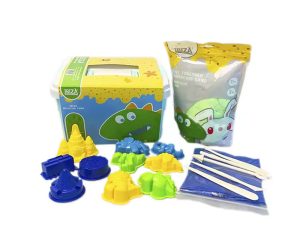
This magic sand kit guide starts with the basics: a kit pairs sand with molds, tools and a tray or container. “Magic” is ambiguous: some kits hold moldable sand that sticks to itself, some hold water-repellent sand, and DIY sets ship plain sand plus colorant. The IBIZA Sand magic sand kit is the moldable type.
What’s in a Magic Sand Kit?
- Mold and beach-style sets: castle, animal and dinosaur molds, often with a bucket.
- Colored sand with a tray: several colors and a tray to work over.
- DIY sets: sand, colorant and decoration packs you mix yourself.
| Spec | IBIZA | Ask any seller |
|---|---|---|
| Sand material | Glass beads with a silicone-based binder | Full material declaration |
| Kit weight | Not published | Net grams per kit |
| Molds and tools | Cake, dinosaur and castle molds available | Exact piece list |
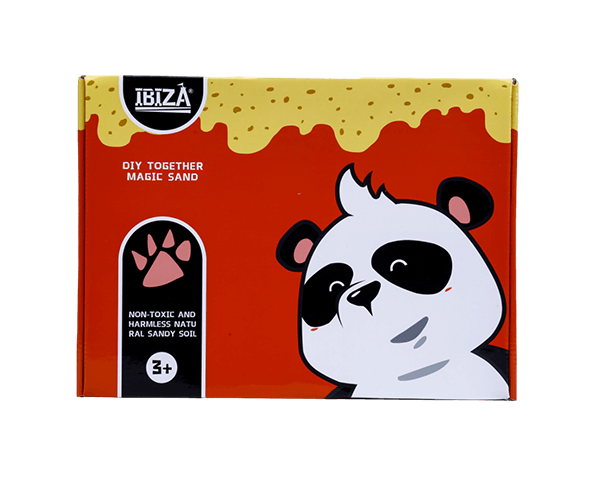
| Age | “Ages 3+” on the panda gift box | Age grading on the pack |
| Safety testing | China 3C certified; EN71 and ASTM tests (including via SGS) | Report for the exact product |
What Is Magic Sand Made Of?
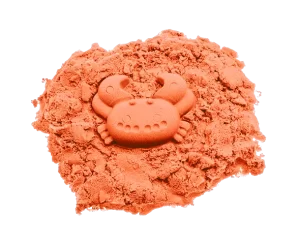
Moldable sand: fine grains held together by a binder, so they cling to each other instead of your hands. Most brands use natural silica sand, whose grains are angular and irregular. IBIZA uses glass beads instead. Glass is itself made mostly of silica, so the difference is not the chemistry but the shape: the beads are melted into smooth, round spheres that roll over one another, which gives a softer, more even flow. The beads are bound with a silicone-type binder, and the result is non-toxic, odor-free and non-sticky. Among its manufacturing steps, IBIZA lists 600 °C high-heat press processing, high-temperature filter sterilization, and purification with repeated polishing; it does not publish further technical detail on these steps. For comparison, the best-known branded kinetic sand is widely reported to be about 98% sand and 2% PDMS (a silicone polymer) binder. Kit weights vary widely by brand, so check the net weight on the pack.
Water-repellent “space” sand: ordinary sand with a hydrophobic coating. Water beads off it, but it does not pack into shapes on a table. Poured into a glass of water, it stays dry, which makes it a classic hydrophobic sand experiment.
How Do You Use Magic Sand?
- Set a tray on a flat table.
- Scoop out some sand and keep the rest sealed.
- Press it firmly into a mold.
- Turn out the shape, then cut, stamp or build with the tools.
- Roll a handful over loose grains to pick them up, then return everything to the container.
Supervise young children and follow the age printed on the kit.
How to Choose a Kit
Check what the sand is made of, whether the tools suit the child’s age, and whether the seller states its testing. IBIZA’s sand is China 3C certified and tested to EN71 and ASTM, including through the testing company SGS; ask any seller for the report covering your exact product and color. Buying loose sand versus a kit comes down to whether you want to source molds and tools yourself. Retailers can contact IBIZA about bulk and private-label kits.
FAQ
-
Why does magic sand not mix with water?
Water-repellent magic sand carries a hydrophobic coating, so water beads up instead of soaking in and the grains stay dry. Moldable sand should not be submerged or washed, because water changes its texture. Wet sand can often be saved if it is dried thoroughly before reuse.
-
What's the difference between kinetic sand and magic sand?
Kinetic sand usually means the moldable, self-sticking kind. "Magic sand" can mean that same sand or the water-repellent kind, and brands use the terms loosely. Check how the sand behaves in the description. Beyond the names, magic sand vs kinetic sand differ in grain, binder, feel and water behavior.
-
What can ruin kinetic sand?
Dust, hair and pet fur contaminate it, mixed colors blend into one shade, and water or wet hands change its texture. Heat and open storage also affect it. IBIZA's sand is formulated not to dry out, but a sealed container still keeps it clean. For crumbly sand, five proven ways to soften kinetic sand can help.
-
How much sand does one child need?
As a rule of thumb, about 250–500 g per child is enough for a tray session. That is enough to fill a few molds and build small shapes without spilling over the tray edge. It is a general guideline, not an IBIZA specification. Larger groups or bigger builds need proportionally more.